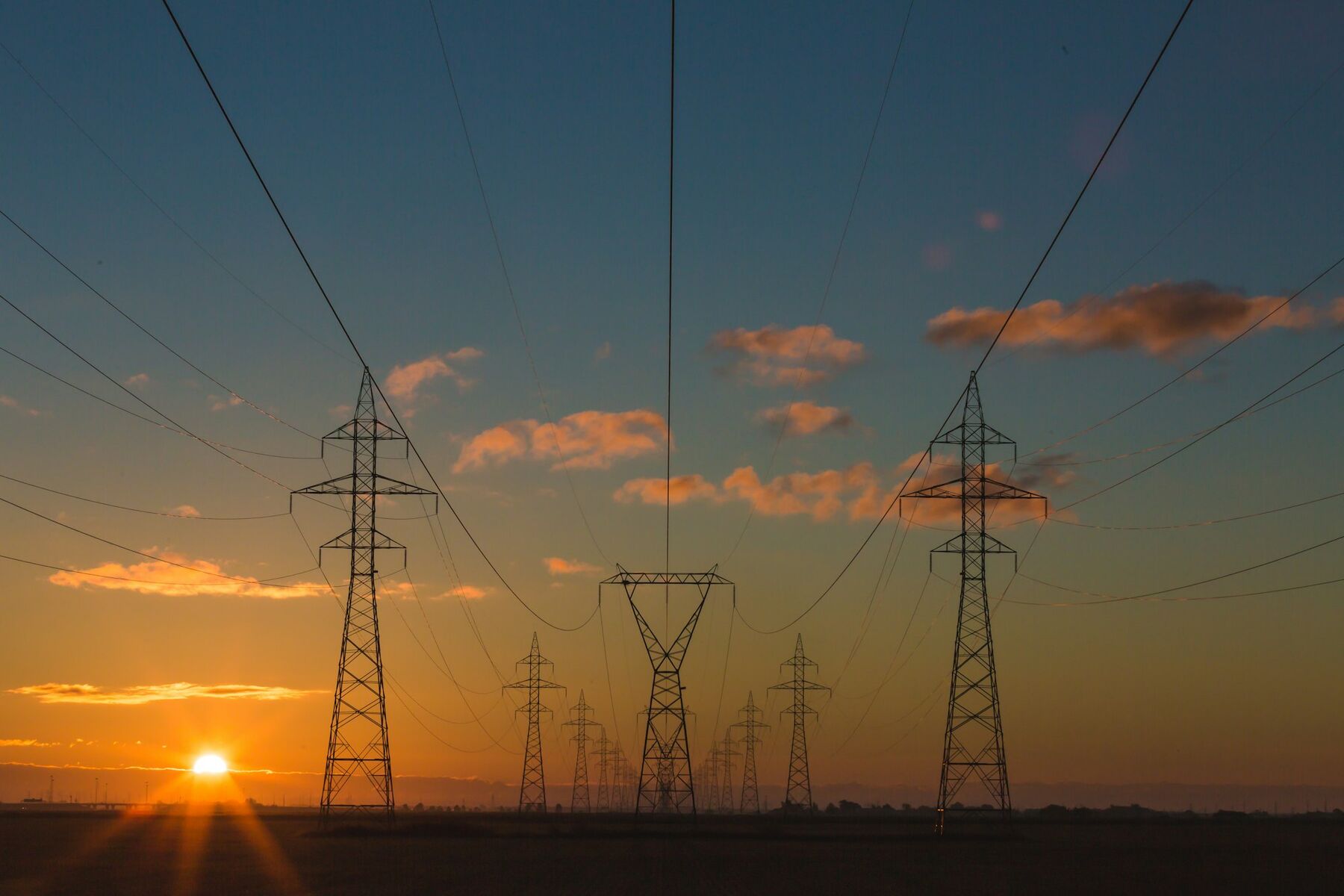
High-voltage electricity transmission infrastructure
Arena Energy — Resources — Land for a Data Centre

A data centre location is decided by grid capacity, not by the size of the plot.

There are plenty of investment announcements and far fewer real projects. Below are the figures that can be verified with the grid operators, the criteria a site has to meet, and the mechanism by which battery storage can take capacity away from a future data centre.

01 — How Much of This Is Real

A dozen or so applications, not hundreds

For well over a year the market has been flooded with announcements. The figures held by the transmission system operator paint a far more restrained picture. The number of grid connection applications for data centres shrank noticeably after a change in the law introduced a compulsory advance payment towards the connection fee, together with a charge for filing the application itself. That financial barrier filtered out the speculative submissions.

This is good news for an investor with a genuine project, because the queue for capacity has become shorter and more predictable. Reports of gigawatts of demand, on the other hand, deserve to be read with caution, since a large share of them was never backed by an actual project.

  • A dozen or so grid connection applications for data centres filed with PSE (Polskie Sieci Elektroenergetyczne, the Polish transmission system operator), covering practically the whole country.
  • More than 6 GW of combined capacity in connection terms already issued.
  • 3.5 GW of data centre demand included in the transmission grid development plan for 2036, and around 5 GW by 2040.
  • Around 10% of connection cases in this segment ended in a refusal in 2025 and 2026.

Who is who in the Polish power sector

On first contact with the Polish market it is easy to get lost in the abbreviations. Three levels are enough to know who to talk to about a specific plot.

WhoRoleWhat this means for an investor
PSE The transmission system operator, a single one for the whole country. It is responsible for the highest voltage grid. This is where applications for the largest capacities are filed, including every data centre application made so far. The operator publishes a list of facilities planned for connection.
The DSOs Distribution system operators (OSD in Polish), each covering its own area of the country: PGE Dystrybucja, Tauron Dystrybucja, Energa-Operator and Enea Operator. Which of them is the competent one follows solely from where the plot lies, not from the investor's choice. They receive the majority of connection applications and they are the ones who know the real availability of capacity at a given point.
URE Urząd Regulacji Energetyki, the energy regulator. It approves tariffs and grid development plans and oversees the legal framework for connections. It does not issue connection terms itself, but its decisions set the rules under which the operators do.

Two operators make data on available capacity accessible as a map that can be used without starting a formal procedure. The others publish information in a narrower scope, so there the starting point is usually a request for connection terms. We return to these tools in the section on site criteria.

02 — The State of the Market

The largest market in the region, and a heavily concentrated one

Poland accounts for more than a third of the data centre potential in Central and Eastern Europe, and available capacity has doubled within three years.

200+ MW
of IT capacity operating in Poland today
74%
of capacity concentrated in the Warsaw metropolitan area
20+
large projects announced across the country
~600 MW
forecast for the next five years, described as conservative

The concentration around Warsaw is at the same time the greatest weakness of this market. Pressure on connection capacity will be strongest exactly where investment is densest, which is why analysts expect projects to shift gradually towards regions where energy and land for a larger campus can be secured more easily and more quickly. That is precisely the window in which a location outside the metropolitan area gains in value.

03 — What a Site Has to Offer

Six conditions to check before the price

Area is the easiest of the criteria and usually the least important. Below is the order in which we verify locations ourselves.

What the planning reform changed
  • A storage facility in charging mode is a consumer. From the grid's point of view it draws capacity in exactly the same way as an industrial plant or a server hall.
  • A very large number of connection terms have been issued for storage. The operator admits that a sizeable share of them may never proceed towards construction.
  • The capacity stays reserved. For as long as the connection terms remain valid it is unavailable to later applicants, whether or not the project is ever built.
  • Competition among consumers themselves is practically absent. There are few industrial applications in the transmission grid, so they are not the problem.
04 — The Mechanism Nobody Mentions

Battery storage competes for the same capacity

PSE states plainly that at the stage of determining connection terms there is, to a limited extent, competition between energy storage facilities operating in charging mode and consumers, data centres among them. In some cases this results in the absence of technical or economic conditions for connection.

For anyone looking for a site for a data hall, this is practical information. An area where a full set of connection terms has been issued for energy storage may be blocked today, even though not a single battery has yet been installed on the ground. Checking this before buying land takes a few days.

What the energy storage market looks like
05 — Why Demand Is Looking for New Markets

London and Frankfurt have run out of power, not customers

In the FLAP-D markets demand has ceased to be the constraint on growth. What limits them is access to energy and the waiting time for a connection. Across Europe, forecasts for 2026 point to around 848 MW of demand against roughly 710 MW of annual growth in available capacity.

On top of that comes regulatory pressure. The EU Cloud and AI Development Act, presented on 3 June 2026, assumes at least a threefold increase in available computing capacity in the Union within five to seven years, alongside simplified siting procedures and better access to energy, land and water. Estimates cited by the Commission put demand from EU data centres at around 60 GW by 2035.

If the established hubs are constrained on energy, that growth has to take place somewhere else. The condition is the ability of a national system to offer predictable connection terms. Poland has an advantage here arising from a low base and spare capacity outside the metropolitan areas, but the window will not stay open indefinitely.

06 — Our Role

What we do and what we do not do

We prefer to draw the line plainly rather than promise broadly. We deal with land and capacity, that is, with what has to be ready before the facility designer starts work at all.

07 — Next Step

Do you have a location, or are you looking for one with capacity already secured?

We will check the capacity, the planning status and the legal status before you commit capital. The initial verification is free, usually within 48 to 72 working hours.

Let's talk about your project
08 — Questions and Answers

The five questions we are asked most often

A dozen or so such applications have been filed in the PSE transmission grid, not hundreds. The number fell noticeably after the introduction of a compulsory advance payment towards the connection fee and a charge for filing the application. PSE has so far issued connection terms for data centres with a combined capacity of more than 6 GW.

Sites of 2 to 5 hectares are the ones most often considered, with spare land for later expansion. Area alone, however, rarely decides the choice. What decides it is the available connection capacity, access to fibre from several carriers and the scope for cooling.

Yes. PSE states that at the stage of determining connection terms there is, to a limited extent, competition between energy storage facilities operating in charging mode and consumers, data centres among them. In some cases this results in the absence of technical or economic conditions for connection.

Around 74 percent of capacity is concentrated in the Warsaw metropolitan area. Connection applications filed with PSE, however, cover practically the whole country, and market analysts expect gradual geographic diversification towards locations where capacity and land are easier to obtain.

No. We source and secure land, verify the genuine connection capacity, run planning procedures and put the legal status of the plot in order. We do not design cooling, we do not build facilities and we do not run certification. We work in the range from a few up to around 30 MW.

09 — Sources and Disclaimers

Where this information comes from

The number of applications, the connection terms issued for more than 6 GW and the demand included in the transmission grid development plan come from replies given by the press office of Polskie Sieci Elektroenergetyczne, as reported by trade publications. The operator publishes the list of entities applying for connection to the transmission grid in its register of facilities planned for connection. The figures on IT capacity, on concentration in the Warsaw metropolitan area and on the five-year forecast come from market analyses by PMR Market Experts and from a guide to the data centre ecosystem.

Information on available capacity is published by the operators themselves. It can be checked with PGE Dystrybucja, Tauron Dystrybucja, Energa-Operator and Enea Operator. The legal framework for connections, tariffs and grid development plans is supervised by the Urząd Regulacji Energetyki (the Polish energy regulator).

This material is for informational purposes only and does not constitute legal, technical or investment advice. The figures show the scale of the phenomenon, not the parameters of any specific project. Capacity availability at a given point in the grid is determined solely by the competent operator in individual proceedings, and it changes over time. Connection legislation has been amended repeatedly in recent years, so the legal position should be verified as at the relevant date.

How the grid connection procedure works